

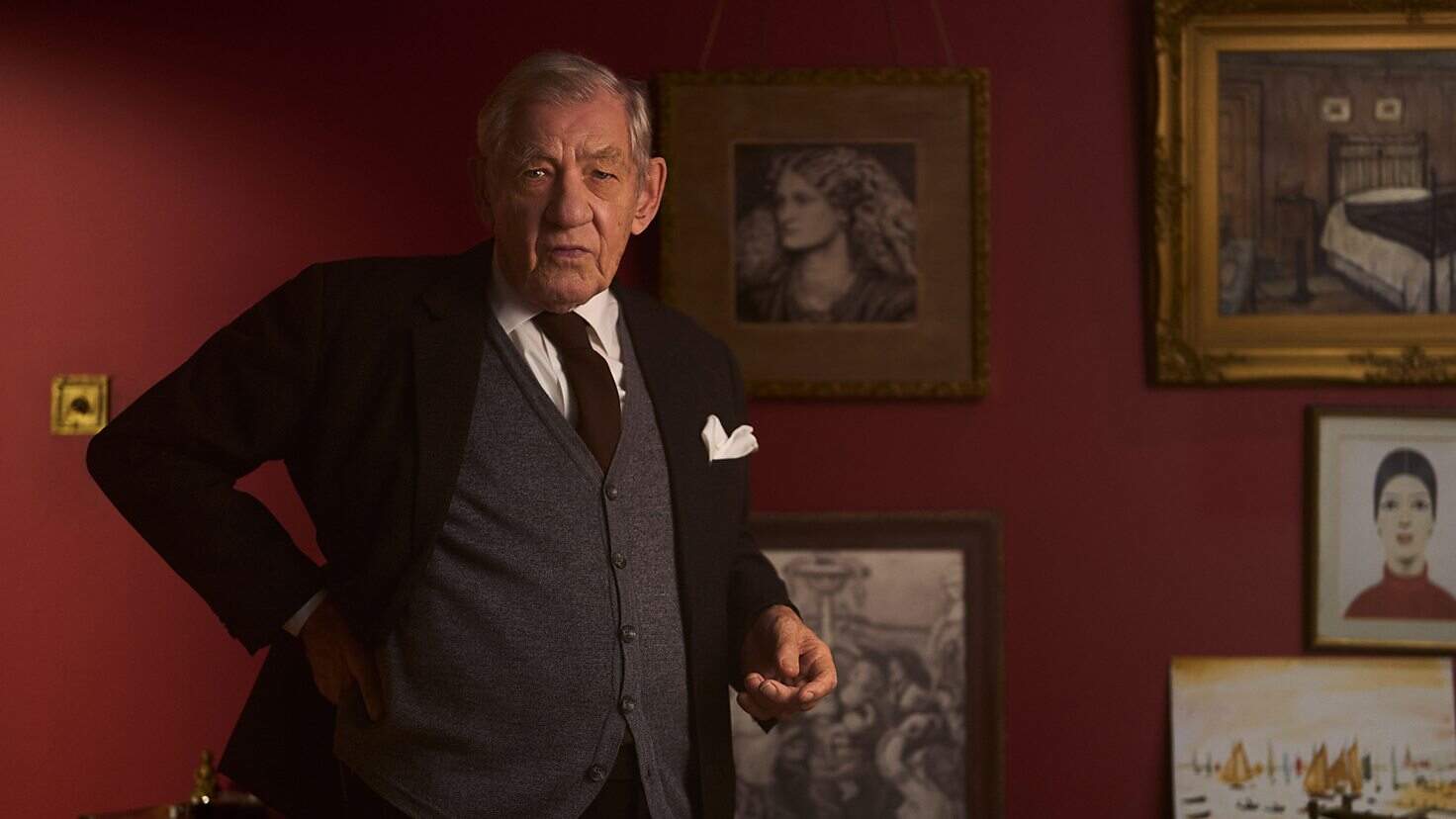

Fifty years after L.S. Lowry’s death, this landmark documentary will bring to light a newly discovered treasure trove of unheard audio tapes recorded with the artist during the final four years of his life, and his reflections on the changing landscapes of Salford and Greater Manchester.
From the comfort of his own living room and inner sanctuary, we’ll hear from Lowry himself, his real voice lip-synced by one of our greatest actors, Ian McKellen. Taking us from the beginning of Lowry’s life to the very end, it will reveal the formative memories and experiences that shaped him as an artist and as a man.
This immersive documentary will foreground the touching, charming exchange between the enigmatic Lowry and his often surprising interviewer, a young researcher called Angela, played by Annabel Smith. But Lowry’s personal narrative also tells a bigger story, of a seismically changing Greater Manchester, where he lived, worked and painted so prolifically.
A BBC Arena film commissioned by BBC Arts from Wall to Wall Media to commemorate the 50th anniversary of the death of L.S. Lowry in 2026. It is commissioned by Suzy Klein and Mark Bell, the Executive Producer is Morgana Pugh, the Director is Peter Sweasey, the Drama Director is James Kent and the Producer is Hannah Mirsky.
BBC Arts Arena documentary, L.S. Lowry: The Unheard Tapes will air on BBC Two and iPlayer at 9pm on Wednesday 25 February.
Ian McKellen interview
How did listening to Lowry’s original tapes shape your understanding of him beyond his public persona?
L.S. Lowry has throughout my lifetime, I think, been the most popular painter in the United Kingdom. So, it’s natural that people should be interested in the man as well as his considerable body of work. But he didn’t give many interviews and those that he did on-record are rather stilted, in that he seems to have worked out his answers in advance.
I think the main impression [in these unheard interviews] we get is of a man who is happy to be answering questions. He doesn’t feel that Angela is intrusive in any way. In fact, he clearly likes being in her company and only occasionally is he wrong-footed as she delves a bit closer into matters that he perhaps hasn’t sorted out, in his own mind.
I think what I’ve found as an actor, trying to match the sound of his words to my face and body, is that he was very much enjoying being in her company
On Lowry and what we discover of him personally in these unheard interviews
He was clearly a man who enjoyed life and lived a long life, and we hear him at the end of his life reminiscing with not many regrets really.
What are the things that you think are most striking about his character?
Well, I’m attracted to a northerner who liked living in the north. Across the Pennines, David Hockney couldn’t wait to get out of Yorkshire and discover the bright lights of the world elsewhere.
Lowry traveled a great deal in the United Kingdom and painted different aspects of it, but he never went abroad. Not interested. Well, there’s a lot to be interested in in Manchester!
Topographically, all the stuff he painted – he painted often empty scenes as well as busy streets and busy urban life. So, he was interested in things beyond his immediate surroundings, but it was the north that he seemed to enjoy most.
I remember my mother saying to me, she never went abroad before she died – and she said she didn’t think it was quite right to go abroad until she’d been to everywhere in the United Kingdom. She said there was enough here to be getting on with, and I think Lowry was rather the same.
I mean he appeals to me as an actor because he clearly loved the theatre, we know that from his reports of his life and he liked the ballet, he liked pantomime. And I think that’s reflected more than people perhaps realise in the paintings and drawings.
You see characters half on and half off the canvases as if they’re hurrying in from the wings or hurrying back to backstage away from the glare of the lights and the attention of the painter. And many of his paintings are drawn from the aspect of someone sitting above the action, as you might be if you were in the dress circle of a theater. He’s look looking down, always an observer. Never part of the paintings.
But you’re drawn into the paintings because invariably there’s a character, I would call them characters, as you get in a play, who are looking out of the canvas at Mr. Lowry. ‘What’s that man doing over there?’ He is their audience. But he’s the director as well as the playwright and it’s all coming out of his imagination, but in a very theatrical way.
Perhaps some people think that he had a rather empty life, except in the middle of the night when he was painting, [perhaps they] have got it wrong and that like many of us he found enormous satisfaction of other people’s lives.
What is the most challenging aspect of lip-syncing Lowry’s real voice?
I’m surprised to discover the most challenging aspect of lip syncing is making your mouth fit the recorded words. And I’ve had great help from Ms. Pugh and Dickie Beau – a friend whose lip syncing is well noted, and I thought I would benefit from the advice of both of them, and indeed I have. It ain’t easy. I don’t find it easy, and I’m amazed at Annabel Smith’s ability.
Because you record a sentence at a time until you’ve got an exact match. I’d be very interested to see what it looks like and I know what it sounds like, but am I doing enough with my face, am I doing too little? I don’t know. It’s a skill which I don’t think you conquer just on one attempt.
But I wanted to do it not just because of my interest in Lowry, but because I thought it would be fun, rather late in my career to have a new ability.
Is it hard to gauge because you’re focusing so much on delivering the audio / the person’s real voice?
What’s surprising about these Lowry tapes is that he gets the inflection wrong. He doesn’t always stress the right word. An actor is very concerned to do that, so that the sense of what’s being said is clear and the intention behind it is clear.
And although it’s obvious what he’s saying and the point he’s making, because of the words which are invariably in the right order, the stress is often in the wrong place.
But it’s been fun for me, beyond the words to perhaps indicate there’s sometimes a twinkle in his eye and a glance to the side that the sound recorders couldn’t have picked up. There’s more going on in these tapes than just the words, I think.
Has there been a moment when you’ve been recording where you’ve felt close to him as a person?
He says of himself that he’s an old gas bag. And perhaps he feels sometimes he talks too much and reveals something about himself that he’d rather have kept private. The intensity of his feelings for his parents, particularly his mother in her latter years, for example. He’s very coy about having had a paid job [other than as an artist].
The image of Lowry, which he must have I think encouraged, is of someone who’s reticent and private. The simple man. Well just as his paintings are a great deal more sophisticated than at first glance – bewildering to the art establishment, I think, but not to the ordinary viewer – and his popularity is astonishing.
And that it remains long after his death is something that I think would have appealed to him no end. But you hear in these tapes he does gossip on, he chatters. You don’t have to draw him out really. You press a button and off he goes. And I think he must have been good company. I know people who knew him well and remark on his rectitude, his politeness, he was a gentleman, someone you would want to call Mr. Lowry.
I don’t think he was too good at being in public… at being a celebrity. But you never know. Perhaps he would have been brilliant on the Graham Norton show, you know. Coming on and just being himself, always looking like himself, always wearing the same sort of clothes. There goes Mr. Lowry!
But he didn’t want to be very famous and all the problems of that. And didn’t need to be because he had many friends. A wide range of friends. and of his family and his own imagination, of course.
Why do you think hearing from Lowry in his own words and his own voice at the end of his life is important?
Well important, I don’t know, of enormous interest. But you can tell an awful lot from someone’s voice. Well, when the actor adds the body and the face, then the presentation is complete.
I mean I wish I had sound recordings of my long-dead family, for example, and I would love to hear my mother’s voice and my father’s. Not just to take me back, but because a voice reveals an awful lot about a person and would tell me things that I didn’t get a chance to understand while they were alive. Well, I think the same’s true with hearing these tapes.
What do you hope viewers will understand about Lowry from this, watching this film?
Well, I would hope no more than that that they’ve been intrigued by the man behind the paintings and will take them back to the paintings because in the end, that’s his prime interest.
I think what’s revealed from these tapes is that he did very much to his work, his paintings. He was a great artist.
And if you want proof of that, you just have to look at a Lowry painting of a crowd, and thereafter you will never see a crowd in real life in the same way. You will say, ‘oh look, that’s a Lowry in real life’. Well, Samuel Beckett made the world realise that life is very much about waiting for God or for Christmas or for happiness or for death. And Lowry reveals a way of looking at people which we all do, but until he put it on the canvas, none of us realised what we were looking at. Well that’s why I’m very interested in Lowry as a person.
Do you feel that resonates, that idea of one’s work leaving behind your own message?
I don’t know quite why he painted all this time. Lowry just can’t stop.
[But] It was all within the framework of what he wanted the painting to be. A very personal view of the world. It wasn’t reportage like a camera.I used to walk to school in Bolton, past the largest cotton mill in the world. It went on and on and on and on down the street. And I can still hear the rattle of the machinery inside. And I don’t have to know what exactly it looked like to remember, what it felt like being close to that large building. And it’s the same with Lowry, you get well, you get a sense of what it was like. But it’s not direct reportage.