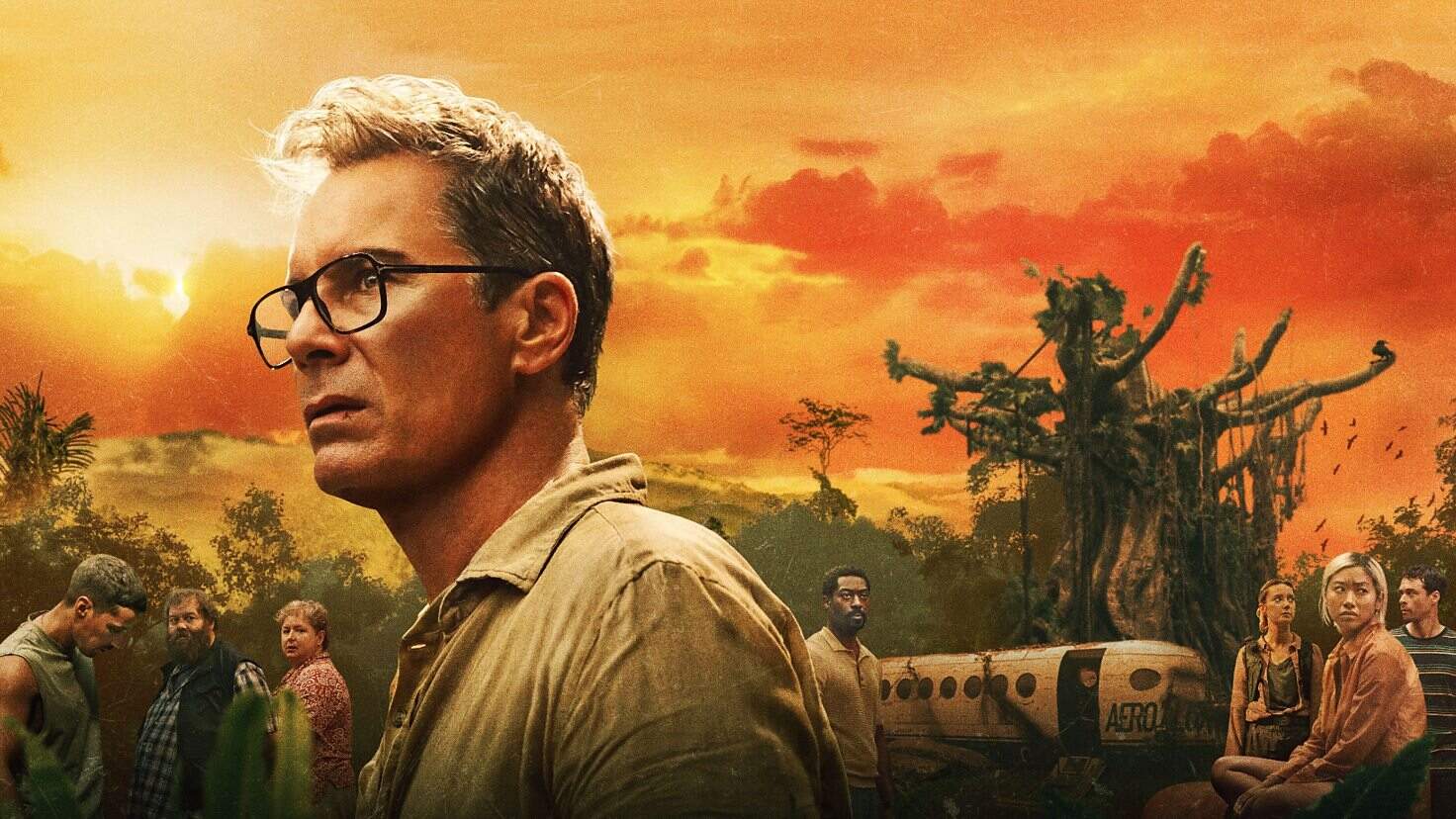
Nine Bodies in a Mexican Morgue is a strikingly original and taut thriller series with a jaw-dropping reveal waiting at the end. A light aircraft carrying 10 people crashes in the Mexican jungle – and nine of them survive. But when, one after another, they begin to die in strange and violent ways they begin to realise that, for some inexplicable reason, somebody wants them dead.
As the story unfolds in flashback, we meet the survivors as they fight against the heat, a shortage of supplies, the many dangers of the jungle – and each other. The setting becomes increasingly tense and claustrophobic until finally the identity of the killer and the truth are revealed.
The series, written by Anthony Horowitz, stars Eric McCormack, David Ajala, Lydia Wilson, Jan Le, Adam Long, Siobhán McSweeney, Peter Gadiot, and Ólafur Dario Ólafsson. Let’s meet them…
Anthony Horowitz
Creator, Writer and Executive Producer
What was the inspiration for the show?
It often occurred to me that an airplane is a very interesting environment for a murder mystery. When you’re sitting on a plane you could well find yourself next to a complete stranger for five, ten or fifteen hours. He or she may seem charming: a doctor, an entrepreneur, a teacher…or a murderer.
And now let’s imagine that the plane crashes into the jungle and you manage to survive. Suddenly your relationship with the other passengers becomes even more critical. You’re in a completely hostile environment. You don’t have very much food or water. Everything is against you. And then, suddenly you realise that one of those complete strangers is a psychopathic killer. What do you do next? That was the start of the idea.
How did you settle on Mexico for the location?
My first thought was that I didn’t want this to be a commercial airliner with two or three hundred people on it, because in order to make that drama I’d either have to have an enormous number of extras on the plane with nothing to do or I would have a great many dead bodies, which would be unappealing, to me anyway. So it seemed therefore that it would have to be a smaller 10, 12 or 15-seater plane and I began to ask myself where was it coming from with a limited range?
Central America seemed like a good idea. It was close enough to The States, the CAA (Civil Aviation Authority) and even the CIA. I loved the idea of a very remote army base with images of desert and sea. I thought about a small plane travelling between Guatemala City and Houston and asked myself where it might crash. Well, half a million square miles of rainforest and jungle full of snakes, spiders and other dangers seemed like a good answer.
When did you settle on the title?
The title came quite late. I knew this was going to be an extreme show with a very unusual, high concept twist coming at the end. It’s something I don’t think anyone will have ever seen before in a TV drama. There were also plenty of shocks along the way. So I realised that I needed a big, bold title and Nine Bodies in a Mexican Morgue more or less fell into my head.
Why did you decide to bring this particular group of characters together?
This is a low-fare airline operating between Guatemala and Houston so I began by asking myself what sort of people would be on it. Also, I wondered what secrets they might be hiding. Everyone had to have a story but I wanted to avoid anything that was too obvious.
I think Lisa and Travis were the first to arrive. Everyone is talking about MAGA right now, often in a negative way so I decided to create two MAGA supporters who were actually sympathetic. I wanted one English character on board, so I created Sonja, the photographer working in charity, helping people trying to cross the border. Divisive politics and immigration are topics that are really relevant internationally right now.
I needed a doctor for the sake of the story but Kevin Anderson (played by Eric McCormack) has been struck off for working without insurance. The Guatemalans do in fact make very good surgical equipment, so I turned him into a salesman who is called upon to use his half-forgotten medical skills. I’ve always liked watching Lucha libre, so it was fun creating Carlos, on his way to a big fight.
Everyone has a story to tell. Everyone has a secret to hide. That’s how it works.
What are the key themes threaded through the six episodes?
It is about how we survive, how we trust each other, how we work together and how we can escape death, but at the end of the day Nine Bodies in a Mexican Morgue is entertainment. I like to think of it as basically a ghost train in an amusement park. You jump on it. It takes you into the darkness. Doors swing open and things jump out. You reach the light when you come to the solution, and this show does have a terrific smile in the very last few seconds. I hope people will enjoy both the solution and what happens next.
Why do you think whodunnits and murder mysteries continue to be so popular?
I don’t necessarily think of the show as a whodunnit or a murder mystery. I hope that by blending genres like horror and murder – with a thriller element too – this isn’t just a mystery that needs to be solved.
I’ve always believed that murder stories are popular because they’re about the search for truth. We live in a world in which it is very hard to be sure of anything any more. We have 24-hour news, fake news, post-truth. How do you know what’s real anymore? But murder mysteries and whodunnits lead to absolute truth. It’s revealed at the end of the final episode. He or she did it…this was the reason why. The community is healed, the story is over, and everybody feels a little bit better for it. I think that’s something we need in this day and age.
What are the key themes threaded through the six episodes?
It is about how we survive, how we trust each other, how we work together and how we can escape death, but at the end of the day Nine Bodies in a Mexican Morgue is entertainment. I like to think of it as basically a ghost train in an amusement park. You jump on it. It takes you into the darkness. Doors swing open and things jump out. You reach the light when you come to the solution, and this show does have a terrific smile in the very last few seconds. I hope people will enjoy both the solution and what happens next.
Why do you think whodunnits and murder mysteries continue to be so popular?
I don’t necessarily think of the show as a whodunnit or a murder mystery. I hope that by blending genres like horror and murder – with a thriller element too – this isn’t just a mystery that needs to be solved.
I’ve always believed that murder stories are popular because they’re about the search for truth. We live in a world in which it is very hard to be sure of anything any more. We have 24-hour news, fake news, post-truth. How do you know what’s real anymore? But murder mysteries and whodunnits lead to absolute truth. It’s revealed at the end of the final episode. He or she did it…this was the reason why. The community is healed, the story is over, and everybody feels a little bit better for it. I think that’s something we need in this day and age.
Eric McCormack (Kevin Anderson) & Lydia Wilson (Sonja)
Can you tell us a bit about the characters you play on the show?
Lydia: I play a character called Sonja, who is from London, and at the beginning of the show she’s kind of questing for something more in her life. She’s been travelling for a little while, so she’s somewhat acclimatised to the jungle – maybe more than some of the other characters – but she’s battling some demons.
Eric: Kevin is a bit of a mystery for a while because he wants to be. We find that he’s running from a divorce and from a lot of disappointment, so he doesn’t share much but we find out a lot more about him as the show progresses.
What hooked you in about it?
Eric: It was almost impossible to say no to, really. It was a delicious six episodes and just a page-turner shot in a beautiful locale. It was great when I realised that I was pretty much the only North American on the show because I got to experience working with these wonderful actors. We bonded so fast. We had the read-through, then we had about five days and we were already best pals by the time we started the first scene, which doesn’t happen very often. So it was awesome.
Lydia: All of the above! It came down the line to me once Eric was already attached, so that was very exciting to me. And with the scripts, I just gobbled them up. They only gave me four initially and I was completely compelled. I thought ‘If this is any kind of metric, once it’s on screen it is going to be even more compulsive’.
What makes Anthony Horowitz such a masterful storyteller?
Eric: He’s like one of those unbelievably intricate clocks, I think that’s the way his brain works. He described to me that it’s about the mechanism of the whole story first, as opposed to the characters. It’s about ‘How can all these pieces fit together and still be surprising as hell?’
Lydia: I absolutely agree. There’s almost a mathematical kind of clarity to him, which I think also means that he avoids a lot of pitfalls in terms of how he doesn’t sort of get off the bus early with his affinities for a certain character. He’s keeping his focus on this North Star of his plot and the mystery and the puzzle for the audience. He’s quite singular in that way. Whether you’re in the English countryside or the Mexican jungle, there’s this engine that is so compelling.
Why do you think audiences love a good whodunnit?
Eric: I think that there’s a certain level of engagement. Years ago on television, both in the UK and in America, the reason series ran forever was because it was like ‘What else are you going to do? There’s only two networks and three series to watch!’ Back then shows didn’t have to evolve as stories, they didn’t have to have surprises or cliffhangers. But as the audience now has more choice, as they’ve become more sophisticated over the last few decades, I think the notion of having something in every episode that absolutely makes you have to tune into the next one has become more crucial. A murder mystery fits right into that need to constantly feed an audience’s interest.
What makes this one unique?
Eric: The setting was certainly unique for me. When I was reading it I was like ‘Oh man, I’ve not done the trapped-in-the jungle thing before and certainly not in a modern context’. With a lot of the murder mysteries, we’ve seen lately, when you think about something like Broadchurch, people live there. They have their secrets because they’re at home, but in this show these people have no business keeping secrets from each other. They should be banding together. They should be working together, but instead everyone’s staying in their corners, and everyone becomes a suspect for the audience because no one’s forthcoming. I think the jungle setting and the fact that they’re miles from nowhere helps a lot.
Lydia: It may be a cliché to say it, but the location is absolutely another character in the show. With the animals, the lizards, they are so charismatic on screen.
Eric: I remember saying to Brian O’Malley, who directed the first three episodes, ‘You’re almost done’ and he was like ‘Today I get to direct the animals!’ He was so excited to have two days in the studio with lizards and snakes and a squirrel and whatever the hell else. He was like ‘They can’t talk back!’
How was it working in that setting?
Eric: For the first few days Lydia and I were walking through actual gardens, jungles and cliffs, and that was great. But much of it was this beautifully constructed set where it became claustrophobic after a while.
Lydia: That made it very helpful and inspiring. It was this fabulous, strange thing in a studio where the set is all around you but when you look up you see all the lights. It was a nice little circuit-breaker sometimes to just look up and remember that we were not really trapped.
Without giving spoilers, did the twists in the script surprise you as much as they will the viewers?
Lydia: Absolutely. It’s a real catnip kind of plot and I couldn’t have predicted where it would go.
Eric: The thing about something like this is that because people are dying – and we know they are from the title – it’s unlike another murder mystery where all the characters survive in order for the detective to come in at the end and say, ‘One of you is the killer’. Here it’s the characters that we get used to, that we love, who suddenly might be gone. That’s what sets this apart and will be surprising for the audience.
How do you think you’d fare if you were stranded in the jungle for real?
Lydia: Not very well based on a recent trip to Wales, where I got lost on a mountain when the sun went down.
Eric: I’d last 30 to 40 minutes. Actually, I take that back. There’s a full bottle of vodka on the plane, so I’d last six to seven hours, until the vodka ran out!
Jan Le (Amy Maclean) & Adam Long (Dan Maclean)
Can you tell us a bit about the characters you play on the show?
Adam: Dan and Amy are newlyweds, they’re coming off the back of their honeymoon, and then they encounter an incredible crisis. Over the course of all of that, their relationship really comes into question. How much do they know about each other?
Jan: Amy is from a very privileged background. She’s a wealthy lady from Silicon Valley and she’s made a very quick and rash decision to marry this man that she barely knows. Now they’ve ended up in the jungle, we’ll have to see how it unravels.
What hooked you in about it?
Jan: First of all, I think the title was a no-brainer. Nine Bodies in a Mexican Morgue is such an intriguing title and that sold it for me. Then there was the fact that Anthony Horowitz had written it and he’s a national treasure, a prolific writer, and it’s always great to work with fantastic writers on telly.
Adam: The title got me halfway there. I heard it and thought ‘What the hell’s going on here?’ And good drama is just people in a room with a problem, right? Here you’ve got these people from all over the place with their own agendas, their own secrets, their own mysteries. You throw them into the jungle with a big problem – they’re being murdered, they’re being picked off. The way that Anthony directs the audience’s attention exactly where he wants it to be at certain times to cast suspicion on everyone else was so much fun, so it was an immediate yes from me.
Following on from that, what do you feel makes Anthony such a masterful storyteller?
Adam: He’s so good at breadcrumbing. He sprinkles all these little breadcrumbs that make you go ‘That’s an interesting beat’ and he doesn’t insult the audience. He lets them form those questions by very subtly offering them these pieces of the puzzle. He’s great at having the audience and the characters figuring things out at the same pace. It makes you feel a part of it as an audience member.
Jan: As much as it is a whodunit, the why is so creative and out there. I don’t think anyone would come to that conclusion when they watch it. I still don’t know how Anthony got from A to B.
Why do you think audiences love a good whodunnit?
Adam: I think it’s because the audience are involved in the story. They’re involved, they’re complicit in the action in a way, and they really feel engaged and part of it. They’re trying to figure it all out just as the characters are and that makes for a very enjoyable viewing experience.
Jan: With a show like this, you actively have to be engaged. It can’t just be background viewing, and because you’re having to concentrate, I think you enjoy it more.
How did the jungle setting aid your performances?
Adam: The first week we had a conversation about bugs and insects, and we were all miming having to swat them away. Then on week two that place came alive. It got to a point where Brian was like ‘I think you’re over-egging it about this whole insect thing’ and we were like ‘No, this is real, we’re being bitten alive’. It really added to our performances in that way because it was fully immersive.
Did these roles present any particular challenges for you?
Adam: I don’t know how to answer that without potentially revealing some plot points, but of course the accent was a challenge. There was also the day-to-day attrition of it, of being constantly doused in water because it’s supposed to be humid; it’s supposed to be 40 degrees, and you are meant to be constantly beaded with sweat. The practicality of that is just before they shout ‘action’ a lady comes over and blitzes you with water. It was about the grind of being wet and hot all day.
Jan: There was one challenge which I won’t give away details about, but there’s a physical scene that pops up in episode three that I found challenging. I have to say thank you to Adam because he was very patient with me that day.
Again, without giving spoilers, did the twists in the script surprise you as much as they will the viewers?
Adam: Yes, I squealed when I read it!
Jan: He squealed, I let out a really deep ‘Nooooooo!’ But we’ve had practice about not giving spoilers. We couldn’t say anything on set because some of the actors didn’t want to know and hadn’t read to the end.
Adam: Annoyingly for my mum, who loves this kind of thing, she came out on a set visit and she happened to see a very specific shot that was basically a damning piece of evidence. She was like ‘Oh, I know who it is now. I shouldn’t have been there on that day, I’ve ruined it for myself’.
How do you think you’d fare if you were stranded in the jungle for real?
Jan: No chance! I’d be gone on day one. I have a very weak constitution. I’d get sick so fast and then I’d probably die from dehydration.
Siobhán McSweeney (Lisa Davies) & Ólafur Darri Ólafsson (Travis Davies)
Can you tell us a bit about the characters you play on the show?
Ólafur: We play married couple Travis and Lisa Davies. They are an American couple, they come from the South, they own a few hotels, and they are self-made people and quite resilient people.
Siobhán: And they’re coming back from holiday in Guatemala. They’re very successful business people who give an extra discount if you have a Trump sticker on your car. They know what they believe in and they know who they are.
What hooked you in about the show?
Siobhán: For me it was a perfect storm of a couple of things. I love this genre and I’m a big fan of Anthony Horowitz’s other work. When I read the scripts I read them like an audience member, so I was really hooked right up to the very last frame. I just couldn’t believe how the story turned around – the twists, the mysteries. Then there was the idea of filming in the Canary Islands for the summer, whereas I usually get to film in Northern Ireland. So, it was like ‘Let’s have a bit of fun’.
Ólafur: I loved the name of the show; the name got me hooked right away. Anthony Horowitz is just so good at what he does, and I was excited to get to work with him. I knew him a little bit before I got the offer to do this show, Siobhán was in it and I’m a big fan of hers, I’m a big fan of Eric McCormack. There were so many things to like about it.
What makes Anthony such a masterful storyteller?
Siobhán: Practice, for one thing! He’s been doing it for a long time. This is a genre that requires technical prowess, there’s a craft, there’s structure and all the minutiae. I think he’s one of the master’s at it because he’s been doing it for a very long time, and you need to have that experience.
Ólafur: I think that’s absolutely true. He has been doing it for a long while and he’s just so accomplished at it. Sometimes when you get almost too good at something, like when you’re too good at math, it’s hard for you to explain it to others. But I think Anthony still has that passion for telling stories, and it was lovely because we got the opportunity to sit with him and have a chat about where the show came from and where he got the idea. I remember it was just so much fun listening to him tell the story of how it came about. He still has that sort of fanboy element to him, and he loves telling stories.
Why do you think audiences love a good whodunnit?
Siobhán: As a fan of the genre myself, I often wonder about that. I find myself watching Law & Order just before I go to sleep and I’m like ‘Is this the right thing to be watching last thing at night?’ because of the cases they tackle on the show. I wonder if there’s just something about being held by the structure. You’re held by the hand through the story and it’s always resolved one way or the other, so you get that sort of catharsis. You get that Greek idea of a full story in a very good package. Maybe that’s why. I work an awful lot in comedy, but the murder mystery is a genre that has almost been around as long as comedy. And I think audiences will want to watch this because there’s no way of knowing what will happen next. Also, we like to solve puzzles. Look at us, we went to the moon.! We like to know things and we don’t stop at imagining things; we smashed stuff open and tried to figure out what was inside it. I think it’s a very human impulse to try and solve mysteries.
Ólafur: Siobhán has nailed it there. And what I love about this show is that the setting is very much man against nature, which adds another level to the murder mystery. Instead of being in a drawing room in a castle in England, these people are actually in real danger from the environment and what’s in it, which I really love as part of the story.
What challenges did the show present to you?
Siobhán: For me, it’s the first time, apart from theatre, that I’ve played an American, so the accent was a challenge. Another challenge would be one that’s the same with every show but especially here because of that locked room mystery idea. You’re going to spend an awful lot of time with these people, and you worry if you are all going to get on. Is there going to be a nice vibe? And it turned out to be one of the most joyful jobs I’ve ever been on.
Ólafur: It was the same for me in a way because I’m not from the South in the USA so the accent was a challenge. Actually, it’s not that difficult, but I don’t want people who know the accent and live in it to be unhappy. That’s basically what you’re trying to achieve, for people to feel represented. Then as Siobhán says, it was such an enjoyable process. I just loved working with the creative team and this incredible cast. We bonded for real; we’re still friends and we’re still meeting up for dinners in different parts of the world, which is lovely.
How was it filming in Gran Canaria?
Siobhán: It was amazing. They’ve got these huge studios and they built that jungle there. I mean, by the end of the shoot, it was alive. It was sort of like a micro experiment, like the Big Bang theory in a bottle or something. They did an extraordinary job.
How do you think you’d fare if you were stranded in the jungle for real?
Ólafur: It’s funny. I’m very much a couch potato and I love my home and watching a good movie. But I’ve also put myself in positions such as hiking or something where I surprise myself – I actually do much better than I ever thought I would.