




(Archived here with Permission utilising The Internet Archive Wayback Machine)
A long time ago, in the Land of the Rising Sun.
In 1991, an up-and-coming stage manager named Scott Faris took a phone call from Kenneth Feld, whose Feld Entertainment ran the so-called Greatest Show on Earth, the Ringling Bros. and Barnum & Bailey Circus. The year before, Faris had been instrumental in helping Feld Entertainment open Siegfried & Roy’s magic show in Las Vegas, which cost a record-setting $28 million to produce.
This phone call was not about Siegfried & Roy.
“Hey, this Lucas thing’s happening,” Feld said. “Come up and meet with me.”Faris gave notice at his current theatrical production. A few weeks later, he flew to Oakland, rented a car, and drove to Skywalker Ranch in San Rafael, California. There he toured Lucasfilm and Industrial Light & Magic with Feld and a group of Japanese businessmen. The party ended up in a boardroom with about a dozen members of Lucasfilm, where Feld took charge. After a day of sightseeing, it was time to talk about why they’d all gathered together.
“The show’s got to be an arena show, and the show has to be two acts, and it has to involve the audience,” Faris remembers Feld saying matter-of-factly. No one else in the room spoke.”I thought ‘Okay, what the hell? I’ll pick up the ball,’ ” Faris remembers. “I said, ‘what I think we should do is find a way to tie together all of George’s films.’ ” Pens rustled on notepads. Again, no one spoke.
So Faris kept talking.”I’m going to create an assignment for you Lucas guys and for myself,” he said. And then he laid out the simple instructions that would soon inspire the most bizarre celebration of Lucas’ films this side of the Stars Wars Holiday Special:
“We’re going to watch the Lucas films, all of them, from five different points of view.What is the thematic high point, the special effects high point, musical high point, comedic high point, and [most memorable] action sequence. I’ll fly back to San Rafael in a week and I’ll meet up with you guys.
“Everyone was on board. With that, the meeting was over. They all went out to dinner. And for the next two years, Scott Faris spearheaded what Kenneth Feld casually referred to as the “Lucas thing,” hiring and directing more than 100 cast and crew for an arena production eventually titled George Lucas’ Super Live Adventure.
Japanese TV companies ponied up $25 million dollars to finance the production. Faris dreamed up a script that combined Star Wars, Indiana Jones, Willow, Tucker: The Man and His Dream, and American Graffiti.
In April 1993, George Lucas’ Super Live Adventure opened to a crowd of more than 10,000 in the Yokohama Arena in Japan.
The show toured Japan for five months.
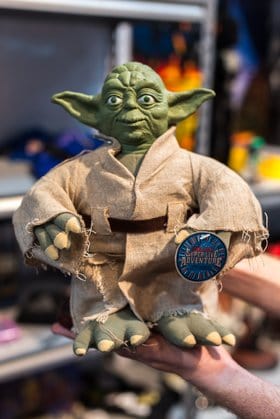
And yet, 20 years later, almost no one has heard of, or remembers, the Super Live Adventure. It persists only in the minds of the Japanese children who once saw the show live, and few remnants–newspaper archives, blurry VHS recordings, tacky merchandise–survive to preserve its memory.
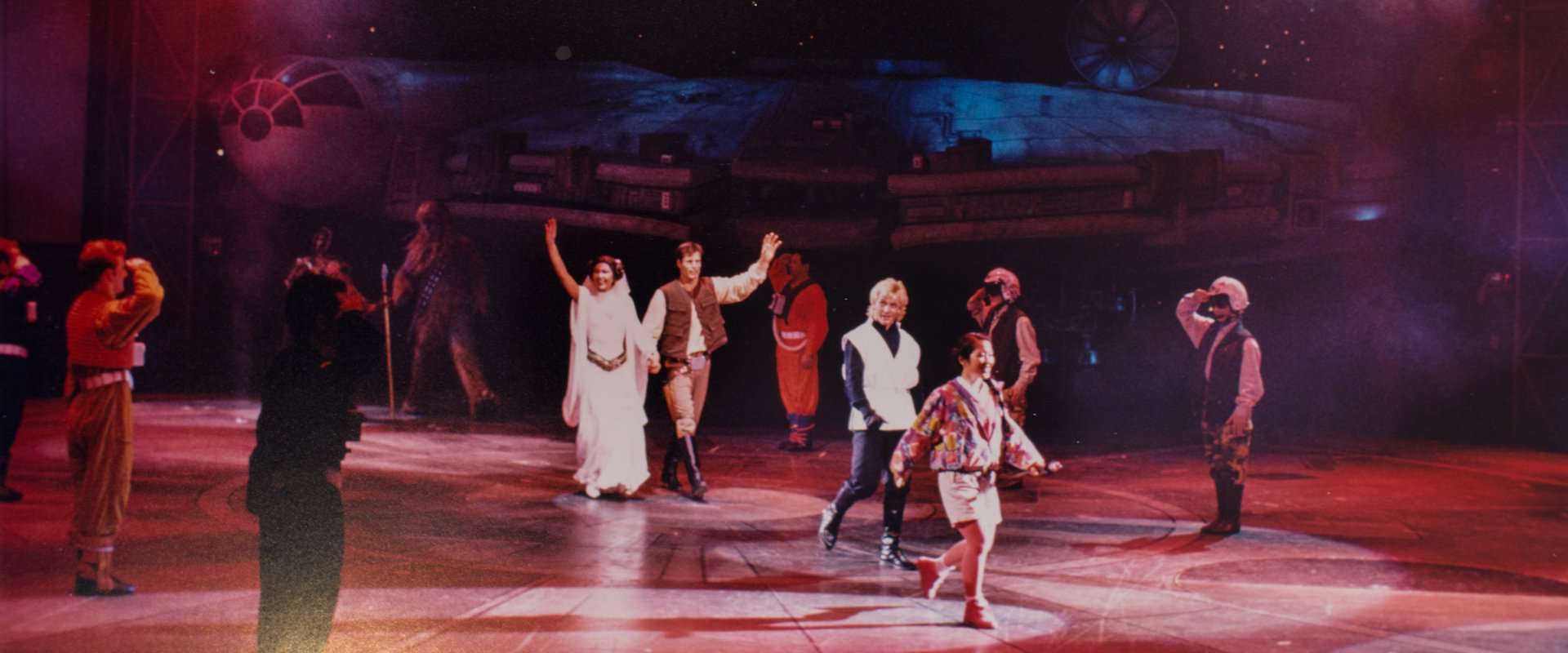
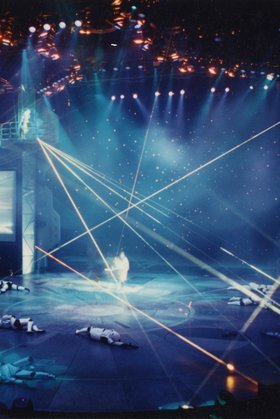
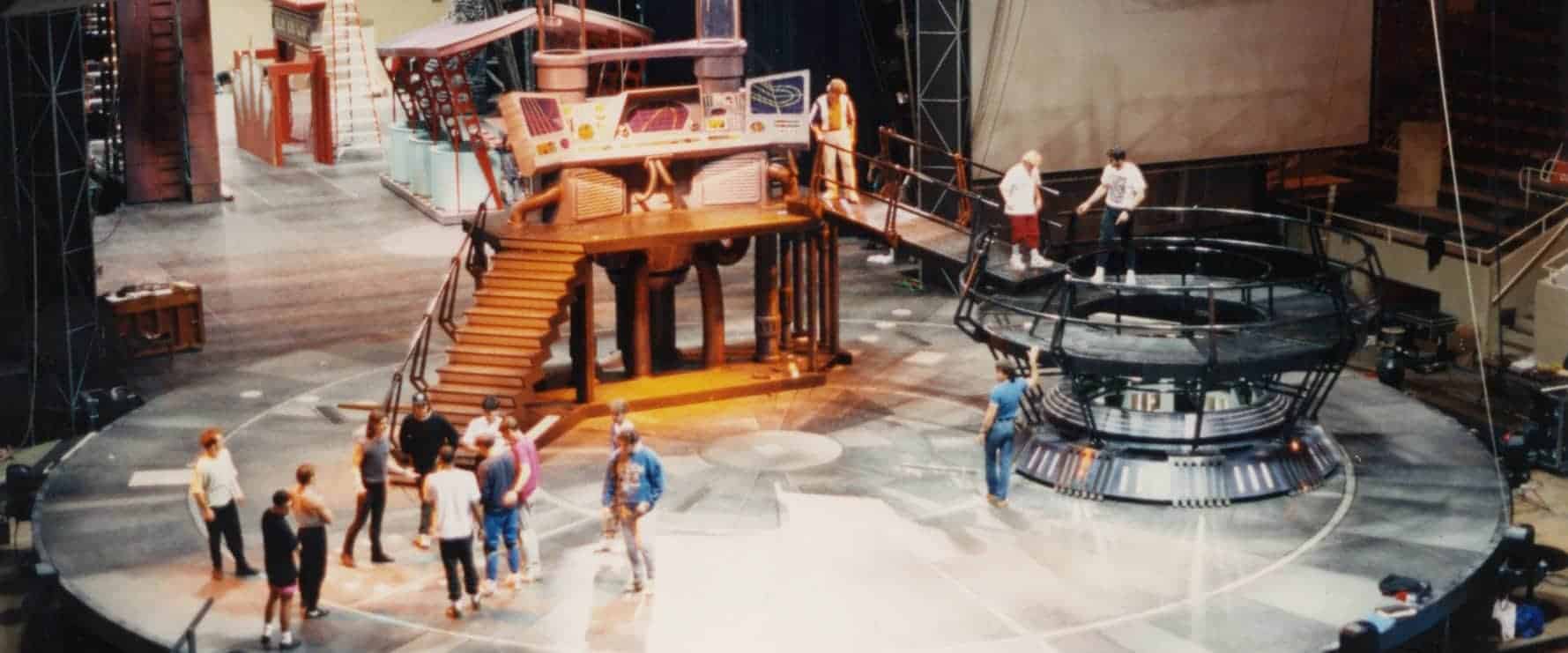
How could such an enormous production, based on some of the most popular films ever made, drift into obscurity? It was elaborately produced, even for an arena show, with an elevated stage 60 feet across, a pair of giant screens showing 70mm projections of Lucas’ films, hand-fired lasers, and a full-scale inflatable Millennium Falcon landing on stage for the finale.
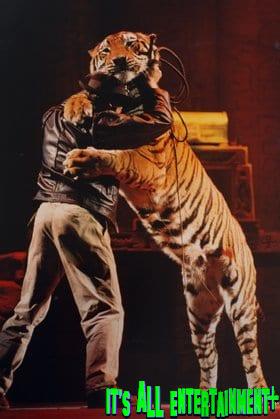
In a single night’s entertainment Willow defeated General Kael, Luke vanquished Vader, the rebels destroyed the Death Star, Nazis unleashed the Ark of the Covenant, and Indiana Jones wrestled with a live tiger. This is the story of how it all happened, how it almost didn’t, and why, 20 years on, barely a trace of George Lucas’ Super Live Adventure remains.

From Lucas Film to Lucas Live
Scott Faris worked for Kenneth Feld Productions on Siegfried & Roy from 1989 to 1990. It was far from his first job in the theater business, but it was a career-changing one. And what a show it was–the production included “75 tons of scenery, the most sophisticated and powerful lighting system ever created, and [a] six-story-high computerized dragon, spitting smoke and flames.” Even in a town built on neon and decadence, Siegfried & Roy’s $28 million production burned blindingly bright. In one famous act, Roy rides atop a white tiger which is standing on a disco ball that hangs suspended above the stage.
To ensure the massive production opened on time, Faris took on on more and more responsibilities. “A lot of it fell into my lap and I was kind of the guy that made that show open,” Faris remembers. He started talking to Kenneth Feld, who would come to Vegas once a month to check up on the show. During one of those conversations, Faris asked for advice on producing a show of his own. He wanted to move up the ladder.
“I’ve got a show,” Feld said. “With George Lucas. Are you interested in that?” Faris’ answer? Hell yes. He leapt at the chance. In 1990, however, there was no George Lucas’ Super Live Adventure. Not yet.
There was just the potential for something.”Kenneth was at the peak of his form,” Faris remembers. “He had brought the circus back to life. There was a big article about him in Time. The Lucas people came to him and said the 20th anniversary of Lucasfilm is going to happen in [1991], and we want to do something for George to celebrate it.”Feld proposed an arena show, and he knew how to pay for it. He’d established Japanese connections a few years before with a successful Siegfried & Roy tour in Tokyo, so he arranged for Japanese broadcast companies NTV, YTV, and Nagoya finance the Lucas production. Everything was ready to go.
Then, in August 1990, Iraq invaded Kuwait, instigating the Gulf War. “Everybody stopped investing,” Faris says. “The Japanese economy kind of went crazy and the Japanese were put on the spot and donated to this war effort, the coalition effort. Everything investment-wise froze in Japan so the thing just disappeared.”A year later, out of the blue, Faris got the call from Kenneth Feld. The “Lucas thing” was back on.
As he promised, Faris spent the week after that first Lucasfilm meeting diligently watching the movies and taking notes. But when he returned with ideas for the production, no one else had done anything. “I started going through all my notes and nobody offered up any ideas,” Faris says. “I walked away from the meeting and called Kenneth and said ‘You know what, these guys just want to be contracted as a division of Lucas Entertainment to create the show. I don’t think that’s right. I think we can create it ourselves.
“Inspired by Lucas’ use of the Hero with a Thousand Faces, Faris decided to create a character whose fate would be intertwined with the adventures of each film.
Super Live Adventure’s central character ended up being a young Japanese-American actress, who would sit in the audience and “randomly” be plucked from her seat at the start of each show. The girl, named Hiromi, traveled through Lucas’ film worlds with the aid of a magic wand, seeking a hero to fight the powers of evil. In the end, of course, Hiromi discovers that she was the hero all along.
A Hero’s Journey
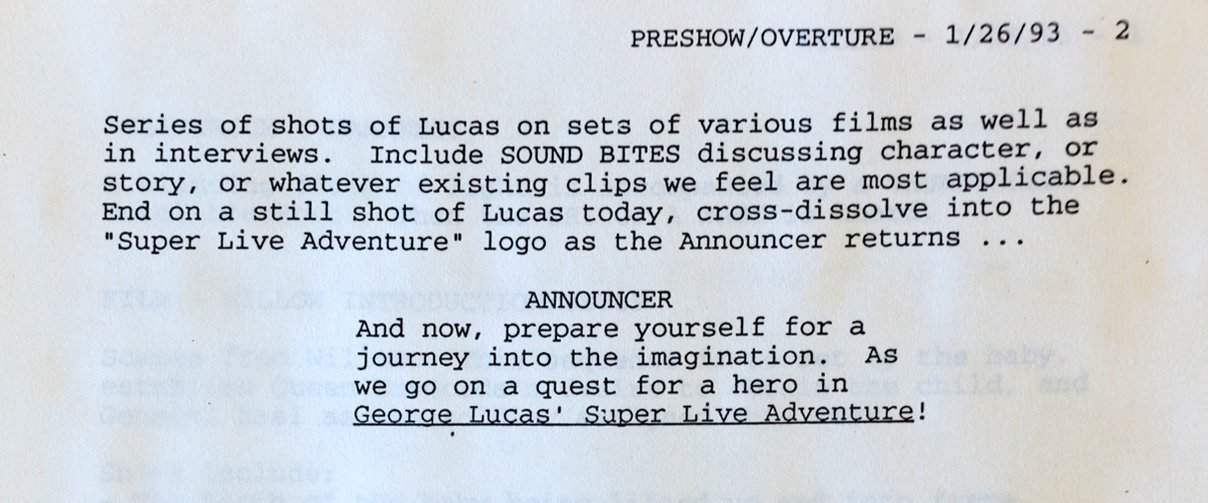
A draft of Gannaway’s GLSLA script dated January 26, 1993 begins with an exuberant description of the show’s opening moments. “Abstract SOUND EFFECTS – the SCREECH of an exotic beast, the ROAR of a Tie fighter, etc. – reverberate through the auditorium, heightening anticipation and hinting at the marvelous things to come. Each of the large screens displays the ‘George Lucas’ Super Live Adventure’ logo.”
“A swiftly edited series of Lucasfilm highlights accompanied by a trumpeting medley of the most MEMORABLE THEMES,” the script continues. “It’s a thrilling, breathtaking, even humorous collection of similar moments from the different films, and all the Lucas heroes…”
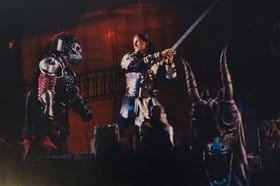
After the opening film montage–which includes clips of Lucas himself directing and working with scale models, just to make sure the fourth wall is good and broken–an actor playing Willow enters from the back of the auditorium and hands a small bundle to Hiromi, who is sitting in the audience. Faris recalls the show’s opening moments beat-by-beat.”He runs up on stage and he’s confronted by the evil General Kael from the Willow movie,” says Faris. “Willow’s frozen with fear and the general comes up on horseback on this giant black Friesian, beautiful Friesian horse, and he climbs down, takes out his broadsword, and he chops Willow in two. And he ends up with only a cloak. It was a great effect.”
[Kael] gets back on his horse and rides off and Willow’s discovered out in the house, and he grabs the girl and pulls her out and brings her up on stage and she’s got a baby. And that’s the baby that the evil queen in Willow wants. This is the setup of the whole show. He brings her up on stage and suddenly they’re visited by this spirit, this fairy that appeared in Willow, and she speaks to them and says ‘We’re looking for a hero to protect us. There’s a dark force coming. And you’ve been chosen to find that hero. Take this wand’–and magically this wand appears. ‘And use it on your journey. It will help you.’“Massive set changes, which regularly exchange one set of towering scenery for another, allow Hiromi and her magic wand to travel through Lucas’ films worlds, some emphasizing grand setpiece moments over familiar narratives. A looming castle with a working drawbridge dominates the Willow set. In the world of American Graffiti, dancers dressed in their best 1950s sock hop outfits twirl across the stage as a giant jukebox towers 15 feet above their heads.
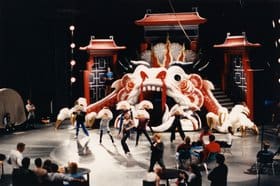
When the lights go up on Indiana Jones’ segment, the action moves from a suspension bridge dangling high above the stage, to Hong Kong’s Club Obi-Wan (complete with giant dragon backdrop), to the Ark of the Covenant. Along the way, Indiana Jones’ nemesis Belloq tries to steal Hiromi’s magic wand, Indy battles a tiger, and the famous face-melting finale to Raiders of the Lost Ark gets its due as Belloq opens the Ark.”
After this moment of beauty, the angelic voices melt into a foreboding chorus of INHARMONIOUS MOANS,” reads the script. “Without warning, a sheet of fire and smoke consumes the altar, blotting Belloq from view. We hear his blood-curdling SCREAM and can practically smell the stench of burning flesh. Then a gust of wind sweeps the smoke away, revealing Belloq’s toasted skeleton!”
In each world, Hiromi gets her own heroic moment, building up to the feel-good final reveal that she was the pure-of-heart hero the world needed all along. The script describes these moments with a childlike excitement as if it, too, is surprised by every twist and turn. When Indy is trapped under a statute as the Ark’s temple set falls to pieces, she saves the day. “Without a split-second to lose, Hiromi plucks the wand off the staff, aims, and wishes!” reads the script. “A beam of light bursts from the wand and connects with the statue. The sculpture’s fall is halted…and it wavers in mid-air! It’s as if Hirmoi is holding the statue up with a single beam of light! An awestruck Indy frees his leg and dives to safety.” Hiromi, of course, is blissfully unaware of her heroism, evne when Indy “pops his hat onto Hiromi’s head” and says “I think you’re the hero around here.”

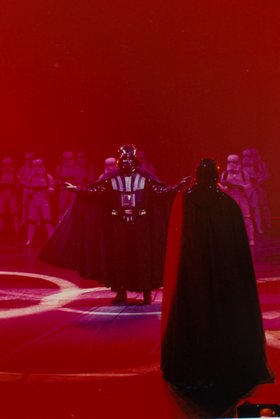
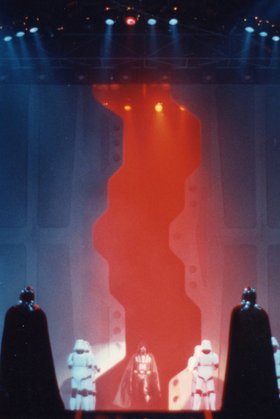
Like the Indiana Jones segment, GLSLA’s Star Wars finale combines the Death Star of A New Hope with the climax of Return of the Jedi, blending the threat to the rebel base with the death of the Emperor–this time it’s Vader who gets thrown down an energy shaft–and Jedi’s climactic space battle. But most of the iconic images from the films actually show up on stage, including Jabba and a life-size Millenium Falcon. Super Live Adventure’s script can’t truly convey the scale of the production, or its quirks; the way the Japanese audio and the actors’ exaggerated motions don’t quite line up, lending the show a slight Power Rangers feel. Or the way combining classic film scenes and brand new ones, like Indiana Jones facing off against a sleepy, disinterested tiger, feels a bit like big-budget fan fiction.
As conceptually absurd as the production is, the scale of the sets, stunts, and special effects is even harder to believe. It took a cast and crew of more than 100 to make George Lucas’ Super Live Adventure work, and nearly two years passed between Faris’ initial meeting with Lucasarts and the premiere in Japan.
Before Hiromi could embark on her Hero’s Journey–before she even had a name–Faris spent months finding his crew. Then, together, they spent an entire year figuring out how to bring Lucas’ fantasies, originally built with scale models and post-production special effects, to live audiences.
Inflatables, Laser Beams, Fantastical Things

Scott Faris’ first hire, before there was even a script for GLSLA, was production designer Douglas Schmidt. Faris knew about Schmidt due to his work on 1981’s Broadway production of Frankenstein. At the time, the $2 million dollar production had been the most expensive Broadway show of all time, and the play infamously closed after a single performance. Schmidt’s grandiose sets weren’t to blame, and Super Live Adventure would need a production designer who could build big.
“Once Doug was on board, Doug and I went on this research phase,” Faris says. “We just flew around the country seeing concerts. If somebody had indoor pyro, we’d go see if. It somebody was using video in some amazing way, we’d go see it. Whatever tickled our fancy, we’d go see, and we’d see how we could work some variation of that into the show.”

“We had nothing–a big pile of Xerox paper to start with,” Schmidt says. “The first thing that I did was arrange a sitdown talk with the folks at Lucas. Mercifully they’re right in the neighborhood. I was able to get access to their archives, which was fabulous. It was like a kid in a candy store. Just to hold those Ralph McQuarrie sketches in your hand, just pull open these drawers and see this whole movie in pictures, painted and imagined, it was truly cool.”
While Schmidt researched Lucas’ films for inspiration, Faris hired more key staff members for the production, including scriptwriter Gannaway, his regular collaborator Jonathan Deans as sound designer, and former My Three Sons actor-turned-musician Don Grady as composer. He hired a Hollywood stunt coordinator to handle stunt rigging and editor Dustin Ebsen to assemble the film clips that would supplement the stage performances. The Super Live Adventure production eventually held auditions in New York and Los Angeles and even Orlando, where stuntmen congregated for gigs at Disney World and Universal Studios.


“There were all kinds of physical problems to deal with,” says Schmidt. “If you look at those movies, and you look at the research materials, everything’s huge. Couldn’t possibly be bigger. Somehow we had to figure out a way to make all of that user friendly enough that we could get it first to Japan, then tour it, because once we got it to Japan it was going to go to three or four different cities.”

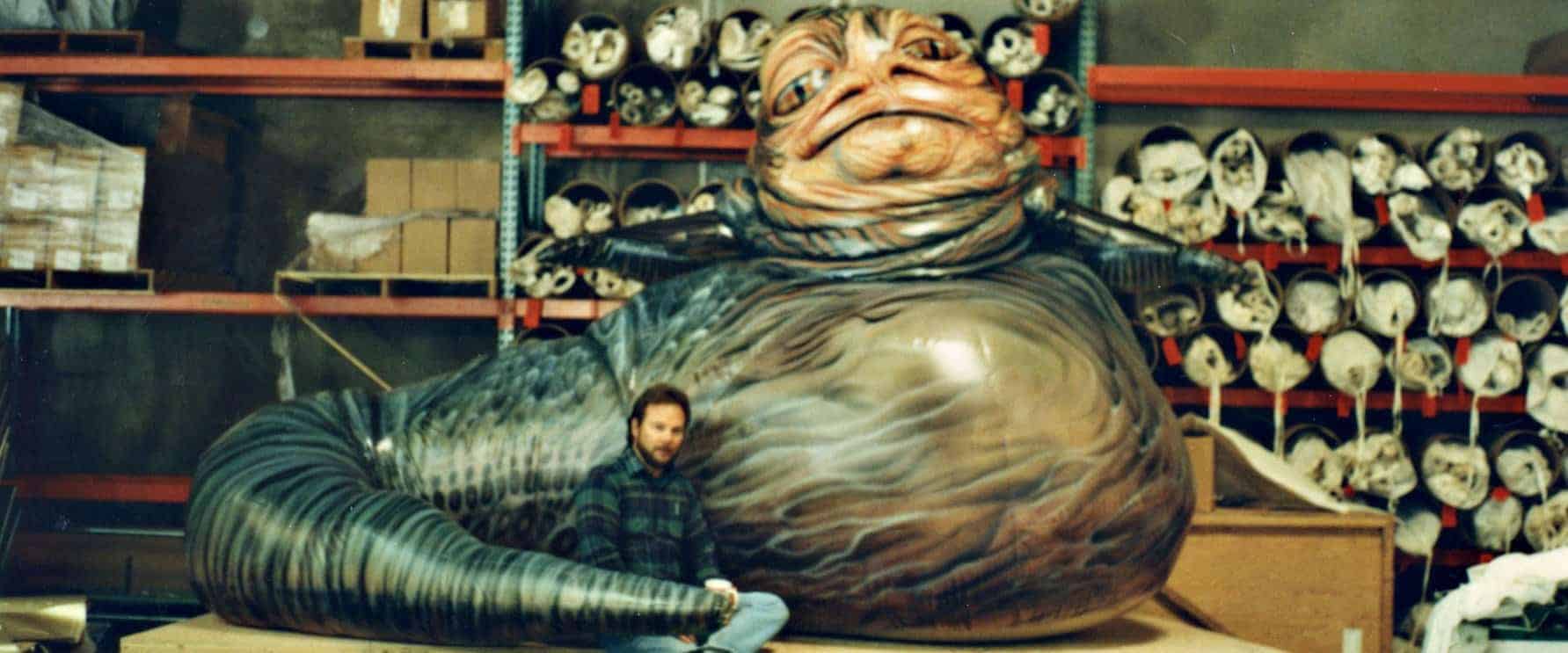
Larger Than Life Inflatables, still in business in San Diego, made the blow-up scenery. Both Faris and Schmidt say that they’ve never seen another theatrical production use inflatables on the same scale. A full-scale Millenium Falcon–or rather, the front half of one–dwarfed them all. The balloon wasn’t quite spaceworthy, though it was based on the original schematics used to design the external set that appears in The Empire Strikes Back.


Many of the sets were constructed from more traditional materials, like the bridge that Indiana Jones fought across; stuntmen and acrobats would have to fall from the wood-and-rope bridge, through smoke obscuring the stage, and into trapdoors hidden in the floor. The temple housing the Ark of the Covenant was reproduced in sculpted foam, and its giant statues would crash to the ground as Indy and Hiromi made their escape. Lucasfilm loaned the production a real Tucker automobile from the 1988 film.

Costume designer Frank Krenz and Kenneth Feld’s prop shop produced more than 400 costumes for GLSLA, including Darth Vader, C-3PO, R2-D2, the aliens from the Star Wars cantina, and more than a few sets of Stormtrooper armor.

Sound designer Jonathan Deans recalls that all of the sound effects came on hard drives from Skywalker Ranch. The screams of the TIE fighters, laser zaps, and lightsaber clashes were straight from the movies. Due to the storage limitations of the time, nearly every scene in Super Live Adventure had its sound files stored on a separate drive.

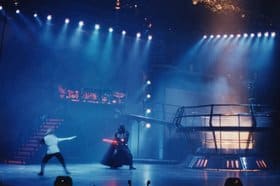
And, of course, there were the lasers, which would likely be replaced by LEDs in a modern production–safer and cheaper, but nowhere near as flashy. For the duel between Luke and Darth Vader, the laser technicians created lightsaber by trapping laser beams within tubes.

By February 1993, George Lucas’ Super Live Adventure was coming together. Feld found an empty arena in North Carolina where the production could set up and rehearse. And rehearse. And rehearse. “We were [there] for two months,” Schmidt says. “Two months in Charlotte. We got it together. We had a show at the end.”
After two months of rehearsal, it was time to ship cast, crew, costumes, sets, and stage to Japan. As the premiere date of Super Live Adventure drew closer, the Japanese financiers prepared to take advantage of something even more popular in Japan than the Star Wars films–George Lucas himself.






Big in Japan
A thin, early-40s Lucas with the first hints of gray in his beard was the face of Panasonic.
In 1987, Matsushita Electric–now known as Panasonic–began a Japanese ad campaign called Something New. A thin, early-40s Lucas with the first hints of gray in his beard was the face of the campaign. Commercials and print ads were created in the US at ILM, with props and models from Star Wars making regular appearances. ILM even built a robot mascot named Sparky for Matsushita that was designed by artist Ralph McQuarrie.

Alongside his role of producer and director for Super Live Adventure, Faris found himself also producing a giant press conference ahead of the premiere.
“They wanted to interview [Lucas] for Japanese TV so they said I should go up and ask George the questions,” Faris says. He met Lucas at Skywalker Ranch briefly during during production in ’92, then flew to Japan to hold the press conference at the Akasaka Prince hotel in Tokyo. Tokyo Disney loaned Faris C-3PO and R2-D2, and they brought in 20 sets of stormtrooper armor and a Darth Vader costume created for Super Live Adventure.


Other than the dubbing, little of the production was catered to the Japanese audience. “[The TV companies] wanted me originally to use a Japanese fight choreographer, and maybe I should’ve,” Faris says. “That would’ve been a good thing, because their swordsmanship was unbelievable. But at the time I was committed to a guy from the theatre who was a broadsword expert…I don’t remember, other than them feeling like they wanted to have a say in it, that there was anything that wasn’t happening.”
On April 27, 1993, George Lucas’ Super Live Adventure debuted in Yokohama.

Doug Schmidt remembers a huge audience at the premiere–and a strange one, to Americans unaccustomed to Japanese etiquette. “The audience response was so muted we thought, ‘Do they hate it?’ We got nothin’. Nothin’ during the show. No applause, no oohs, no ahhs, nothin’. They might as well have been dummies sitting there. Then at the end, they went crazy, they loved it! But nothing during the show, which threw everybody. We didn’t know what the hell was going on.”

Faris remembers sitting in the royal box with his wife and George Lucas, who returned to Japan to watch the premiere. Lucas, at least to Faris’ recollection, loved the show; he later brought his daughters to see it in Osaka.
Through spring and summer, Super Live Adventure toured Japan’s arenas, drawing big crowds at each location. As it toured, Feld flew over American entertainment bigwigs in hopes of setting up a US tour. The production sold mounds of merchandise to help recoup costs.
But by the end of Japan’s summer, the show was finished, packed up, and shipped home for storage. It’s been fading into obscurity ever since, begging a question that’s difficult to answer today: was George Lucas’ Super Live Adventure actually any good?
The Show Goes On, Until It Doesn’t
“We were so proud of it,” Scott Faris says. “It was so much fun. We explored things that hadn’t been done and everybody on the creative team was just into it. They were ready to try anything and make it work.”

Faris and his crew pulled off a technological feat with Super Live Adventure, but that technology suffered its share of technical problems. Faris, Schmidt, and sound designer Jonathan Deans all remember one disaster differently. According to Deans, there were multiple generators in trucks parked outside the arena, which were used to provide extra power necessary for the show. During one show–maybe opening night–one of those generators exploded.
“It actually blew up,” Deans says. “Parts of the generator flew out of the truck and landed on other cars parked in the car park. It was just as Mad Martigan in Willow was about to have his head cut off.”
The generator’s explosion fried every MIDI chip in the sound system, which they used to send commands between audio devices. Deans and his team had to trigger and mix all of the sound effects and music manually. On other nights, the projectors refused to send the proper timing signature to the audio gear, causing sound to regularly cut out as film clips were being played–and to come back on with a deafening explosion.

The scariest incident–and the funniest in retrospect–came during rehearsal in North Carolina, when one of the tigers escaped from its trainer. Deans remembers the tiger being freaked out by a shiny gold prop for the Indiana Jones segment, attacking it, and running loose. The tiger, he says, was “really fucking pissed.”
The escaped tiger was “really fucking pissed.”

Still, neither safety nor reliability were seriously detrimental to the show’s brief run. All productions of that scale are going to have their problems. Ultimately, if George Lucas’ Super Live Adventure had a critical weakness, it was the story.


The Super Live Adventure stage simply took too long to assemble and disassemble to support a brisk US touring schedule. Sadly, right around the same time Tait Towers built the stage, they also developed a new rolling stage for rock concerts. Rolling arena stages could be set up in one part of the arena while lighting and sound were hung from the ceiling, then wheeled into place, effectively cutting setup time in half. But too much money had already been sunk into the Super Live Adventure stage. They couldn’t ditch it and build a new one.

“My next show after that was EFX and it opened the MGM Grand Hotel in Las Vegas,” Faris says. “One of the CEOs of one of the theaters called me and said, ‘I heard about your Lucas show. Can you put it in my theatre?’…I went down and looked and I said, ‘You know what, it’s not high enough. The ceiling’s not high enough. We can’t fit the scenery in.’ You know, the temple for Indiana Jones was like 30 feet high, and our grid was another 10 feet over that.’ ”

They’d been taking up too much space. Feld Entertainment threw everything away.
A Vision of the Future


Other pieces are genuinely cool, and even a little awe-inspiring, like the poster of George Lucas, staring straight ahead in a pair of aviators, presented in an orange-tinged silhouette. In his San Francisco studio, Doug Schmidt still has the show’s official poster, which combines everything from Willow to Star Wars into one image, mounted above his drafting table. That poster manages to capture the essence of the classic hand-painted posters for Star Wars and Indiana Jones, deftly avoiding the campiness of Super Live’s other memorabilia.

Even video evidence of the show is scarce. Neither Faris or Schmidt know if the production was ever recorded by the Japanese broadcasters or aired on television. Footage shot from the audience exists–you can find it on Youtube–but you’ll be hard pressed to see the details of Schmidt’s sets or Krenz’s costumes.

Faris believes so. “I was out in Vegas working on a show last month and looking at all these crazy shows around Vegas…and I thought, man, that Lucas show would’ve worked today,” he says.

Jonathan Deans feels the same. “To do that show now would be stunning,” he adds. “All the technology, we could do that easily now, in every aspect. Technology has grown up and we’d be able to do that in our sleep almost. But of course, we’d make it a lot better.”
With the Disney empire now behind Lucasfilm, a new arena show celebrating Lucasfilm’s legacy doesn’t sound so outlandish. After all, Star Wars’ 40th anniversary is coming up in 2017.
And Lucas has always enjoyed a spectacle. As that extravagant Japanese press conference wrapped up in Tokyo before GLSLA’s tour, after Lucas’ lunch with Scott Faris and a day devoted to endless interviews, the creator of Star Wars gave the director of Super Live Adventure one piece of advice.
“He said, ‘Hey, have a great show, and just remember: do what I do,’ ” Faris remembers. “I said ‘Yeah, what’s that?’ And he said, ‘Save the big explosion for the end.”
by Wesley Fenlon